Virginia Otis and Sir Simon de Canterville
The Canterville GhostThe relationship between Virginia Otis and Sir Simon de Canterville turns the ghost’s long history of failed hauntings into a story of compassion and release. When Virginia finds him sunk in melancholy, she does not flee or treat him as a spectacle. She listens to his exhaustion, accepts the risk of helping him, and becomes the person whose tears and prayers can fulfill the prophecy and bring peace to Canterville Chase.
An Encounter Shaped by Pity
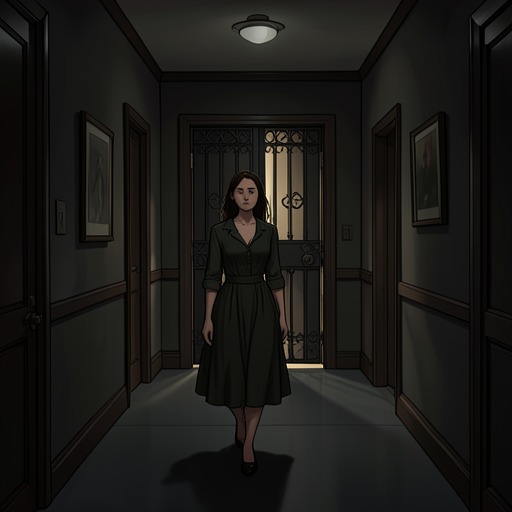
A few days after the twins have repeatedly disrupted the haunting, Virginia returns from riding on Brockley meadows with her habit badly torn. Trying to avoid being seen, she takes the back staircase and passes the open Tapestry Chamber. She expects to find her mother’s maid, but instead sees the Canterville Ghost sitting by the window, watching the yellowing trees and red leaves fall along the avenue. His head rests on his hand; his posture and neglected appearance make him seem forlorn rather than frightening.
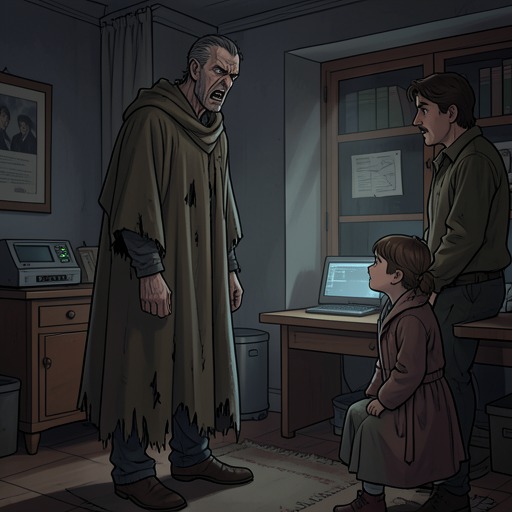
Virginia’s first impulse is to run and lock herself in her room. Pity displaces that fear, and she decides to comfort him. She apologizes for his treatment and says that her brothers will return to Eton the next day, so no one will annoy him if he behaves himself. The offer is both practical and mistaken: Virginia approaches the haunting as an avoidable household nuisance, while Sir Simon understands it as the only purpose left to him. He insists that rattling chains, groaning through keyholes, and walking at night are his reason for existing.
Virginia challenges that claim rather than accepting it as an excuse. She tells him that haunting is no reason to exist and reminds him of the story Mrs. Umney told the family: Sir Simon killed his wife. The exchange makes their bond morally serious from its beginning. Her compassion is not a denial of his wrongdoing, and his need for comfort does not erase the crime that has shaped his afterlife.
Weariness, Remorse, and the Need for Rest
Sir Simon asks Virginia not to leave. He says that he is lonely and unhappy, and that he wants to sleep but cannot. Virginia initially answers with the ordinary logic of a living child, treating sleep as something easily obtained by going to bed and blowing out a candle. His reply reveals the scale of the difference between them: he has not slept for three hundred years and is desperately tired.
Virginia’s response changes when she understands that his complaint is not a trick or another performance designed to frighten her. She grows grave, approaches him, kneels at his side, and looks up into his withered face. Her question about whether he has a place where he can sleep brings the relationship to its central need: Sir Simon seeks not victory over the living but an end to the condition that has kept him awake and unresting.
He names the Garden of Death as the place he longs for. Death, he explains, would mean lying beneath the grass, listening to silence, and being free of yesterday, tomorrow, time, and life. He asks Virginia to open the portals of death’s house, telling her that love is with her and stronger than death. The request makes her sympathy consequential: she is not merely consoling a lonely ghost but being asked to help end his supernatural existence.
The Prophecy and Virginia’s Choice
The terms of their bond are set out in the Canterville prophecy. Sir Simon explains that Virginia must weep for his sins because he cannot weep himself, and pray for his soul because he has no faith. If she has remained sweet, good, and gentle, the angel of death may have mercy on him. He also warns that she will see fearful shapes in the darkness and hear wicked voices, though these cannot harm her because the powers of Hell cannot prevail against the purity of a little child.
Virginia does not answer immediately. Sir Simon wrings his hands as he looks down at her bowed head; then she stands, very pale, and says firmly that she is not afraid and will ask the angel to have mercy on him. Her decision converts the prophecy from an obscure condition into an action she knowingly accepts. At fifteen, she is a child within the family, but the ghost’s release depends on her moral agency rather than on the authority of the adults around her.
Sir Simon rises with a cry of joy, takes her hand, bows over it with old-fashioned grace, and kisses it. His fingers are cold as ice and his lips burn like fire, but Virginia does not falter. He leads her across the dim chamber while the embroidered huntsmen on the faded green tapestry warn her to go back and the carved animals at the chimneypiece urge her to beware. She shuts her eyes against the figures and continues with him. When the wall fades like mist, a black cavern appears; a bitter wind sweeps around them and something pulls at her dress. At Sir Simon’s urgent warning, they pass through, and the wainscoting closes behind them, leaving the Tapestry Chamber empty.
Release and the Secret Revealed
Virginia’s disappearance alarms her family. When she is found, she tells Hiram B. Otis that she has been with the Ghost, that he is dead, and that he was very wicked but truly sorry for what he had done. She adds that he gave her a box of beautiful jewels before he died. Her account confirms that she has returned not merely from a dangerous passage but from the encounter that has ended Sir Simon’s existence as a ghost.
She leads the family through an opening in the wainscoting and down a narrow secret corridor. Washington follows with a candle, and they reach a heavy oak door studded with rusty nails. Behind it lies a small, low room with a vaulted ceiling and a single tiny grated window. A huge iron ring is fixed in the wall; chained to it is a gaunt skeleton, stretched across the stone floor with its fingers reaching toward a trencher and ewer placed just beyond reach. The ewer is green with mould inside, and the trencher holds only dust. This is the concealed physical truth behind the ghost story: Sir Simon was chained and left to starve in the secret chamber.
Virginia kneels beside the skeleton, folds her hands, and prays silently while the family looks on in horror at the tragedy now disclosed. The twins then call attention to the withered almond tree, which has blossomed visibly in the moonlight. Virginia rises and says that God has forgiven him. The flowering tree supplies the prophecy’s promised sign, joining her prayer to the end of the house’s haunting and to the possibility of peace.
A Bond That Outlasts the Haunting
The relationship’s resolution is not only the disappearance of a ghost. Virginia’s later words preserve her connection to Sir Simon as a secret bound up with her emotional life. When Cecil, Duke of Cheshire asks whether she will one day tell their children the secret, she blushes. The earlier passage had made Virginia the witness and helper in Sir Simon’s release; the later exchange indicates that the experience remains hers to remember and eventually share.
Sir Simon’s bond with Virginia is therefore defined by an exchange that neither excuses his crime nor leaves him trapped in it. He entrusts her with the need he cannot meet himself: to mourn, pray, and guide him toward rest. She crosses the chamber despite its warnings, and the revelation of his chained remains gives her intervention a concrete human cause. The story’s contrast is decisive: the adults and twins have treated the haunting chiefly as an inconvenience or a joke, while Virginia recognizes the suffering beneath it. Through her compassion, the restless ghost receives the mercy he could not secure alone, and Canterville Chase becomes still.